Iron overload by age in patients with PK Deficiency - Peak Registry poster
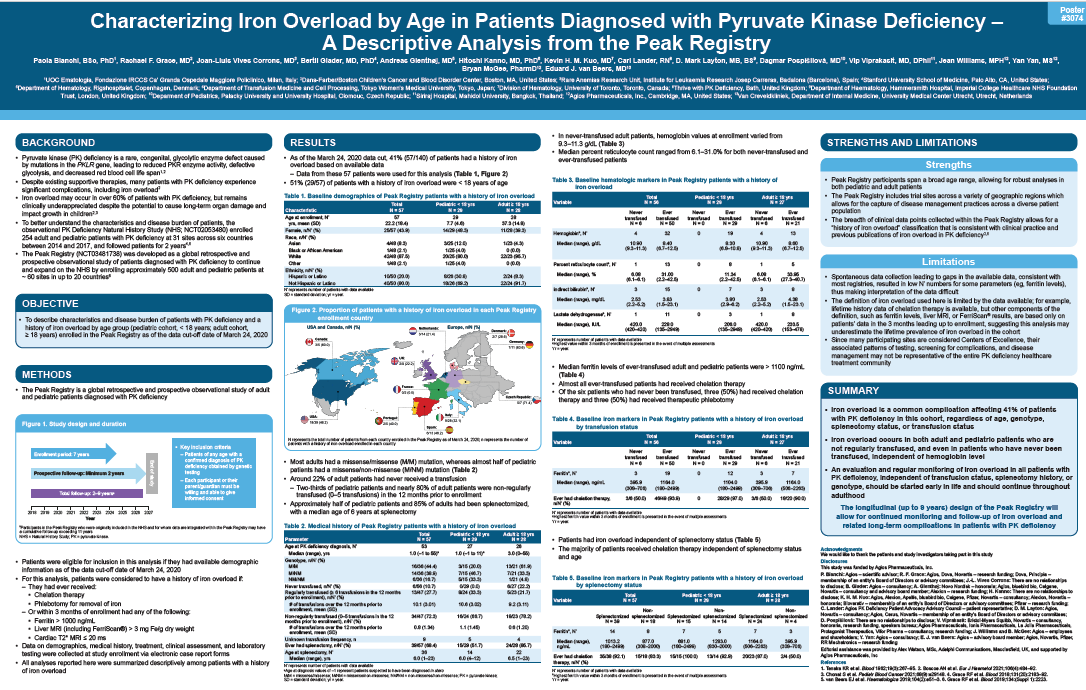
A scientific poster presenting an analysis of iron overload in patients diagnosed with Pyruvate Kinase Deficiency. The poster includes sections for background, objectives, methods, results, strengths and limitations, and a summary. It features data tables, demographic maps, and a study timeline.

Summary

• Iron overload is a common complication affecting 41% of patients with PK deficiency in this cohort, regardless of age, genotype, splenectomy status, or transfusion status

• Iron overload occurs in both adult and pediatric patients who are not regularly transfused, and even in patients who have never been transfused, independent of hemoglobin level

• An evaluation and regular monitoring of iron overload in all patients with PK deficiency, independent of transfusion status, splenectomy history, or genotype, should be started early in life and should continue throughout adulthood

The longitudinal (up to 9 years) design of the Peak Registry will allow for continued monitoring and follow-up of iron overload and related long-term complications in patients with PK deficiency

Link to Peak site: tbc

Comorbidities and complications in adults with pyruvate kinase deficiency according

to hemoglobin strata: A descriptive analysis from the Peak Registry - Peak Registry poster

Scientific poster titled 'Characterizing Iron Overload by Age in Patients Diagnosed with Pyruvate Kinase Deficiency — Descriptive Analysis from the Peak Registry'. The poster includes sections with background, objectives, methods, results, strengths and limitations, and a summary. Contains graphics, maps, and data tables related to iron overload in PK deficiency patients.

Summary

• Patients with PK deficiency and less pronounced anemia (Hb >10 g/dL) experienced a wide range of comorbidities andcomplications

• As with patients with lower Hb levels, patients with Hb >10 g/dL also had hemolysis, iron overload, transfusion requirements, and the need for chelation therapy

• Furthermore, patients with Hb >10 g/dL experienced serious complications and symptoms of PK deficiency, such as bone health complications, biliary events, and jaundice.

• A limitation of this study is that, as splenectomy improves Hb, this analysis cannot establish whether the complications observed in these patients occurred prior to or after splenectomy and the subsequent increase in Hb

All patients with PK deficiency, regardless of Hb levels, may benefit from careful monitoring to reduce the risk of long-term complicationsup of iron overload and related long-term complications in patients with PK deficiency

Link to Peak site: tbc